

REFORESTATION
Reforestation aims to recover the ecological integrity of ecosystems, considering environmental, economic and social values. In the medium and long term the structure, productivity and diversity of the forest must be re-established in order to achieve the maximum possible resemblance to the original forest.
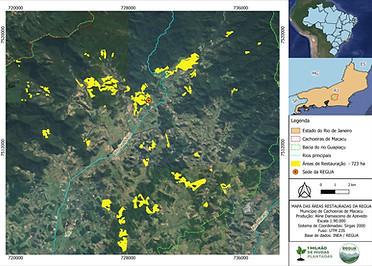
In addition to the mission of preserving the Atlantic Forest remnants in the Guapiaçu river catchment area, REGUA is committed to restoring the natural landscapes and promoting the region's environmental quality. In order to increase the protected area and gain scale in restoration, since 2001 REGUA has been acquiring both remaining forest fragments and degraded pasture areas for recovery through reforestation. From the conversion of degraded areas, the islands of forest fragments are gradually connected and large ecological corridors are created to guarantee the genetic flow of the species found only in these habitats. One of REGUA's main objectives with forest restoration, in addition to maintaining biodiversity and preserving species, is to contribute to the conservation of the Guapiaçu river catchment area, since this is an important supply of clean water, responsible for supplying water to millions of people who inhabit part of the metropolitan region of the state of Rio de Janeiro.

"Memorial Forest" area - © REGUA

Native tree seeds are collected from the forests.
(© Barry Yates)

Nursery team showing seeds to school kids.
REGUA archive ©
Since 2004, REGUA has been recovering degraded areas of slopes and lowlands, mainly restoring original forest and lentic ecosystems in Permanent Preservation Areas - APP, such as springs, river banks and swamps. But this was only possible thanks to important partnerships established over that time, such as Brazilian Atlantic Rainforest Trust, Petrobras, World Land Trust, SOS Mata Atlântica, DOB Ecology, Saving Nature, Conservation International, Iniciativa Verde, Ecosia, WWF-Brasil, International Institute for Sustainability (IIS), INEA and CEDAE.
In 2013, REGUA was recognised as an Advanced Post of the Atlantic Forest Biosphere Reserve (RBMA), the largest biosphere reserve of forested areas on the planet. We are effectively contributing to the establishment of a harmonious relationship between human societies and the environment in the Atlantic Forest area. REGUA also participates in the Pact for the Restoration of the Atlantic Forest, together with over 100 institutions from different sectors of society, including the Mata Atlântica Network (RMA), RPPN Network and the Association of Seed and Seedling Producers of the State of Rio de Janeiro (For Seedlings Rio).
In the same year REGUA was awarded Petrobras' public conservation award through the Petrobras Socio-environmental Programme this gave REGUA the opportunity to gain scale in its ecological restoration actions. The project this was initiated in September 2013 and continued until to March 2022. This resulted in REGUA being able to double the number of trees planted on both REGUA land and on land owned by partners in the local area. REGUA also continues to monitor these replanted areas to ensure their continued growth and success.
For forest restoration to be successful we carry out three phases: preparing the area, planting the seedlings and maintaining the areas after planting. To achieve this, initial planning takes into account the environmental characteristics of the area to be planted, which mix of tree species would be most suitable and whether there are any technical difficulties to be overcome (for example, access to the site, the degree of slope on the land, removal of old fences or buildings).
Once planted, the young trees require support for several years to ensure we achieve the structure, diversity and productivity necessary to recreate a forest as near as possible to the original.

Collaborator planting a sapling - © REGUA

Reforestation team - © REGUA

Nursery workers organizing seedlings - © REGUA

Reforestation team in full activity - © REGUA
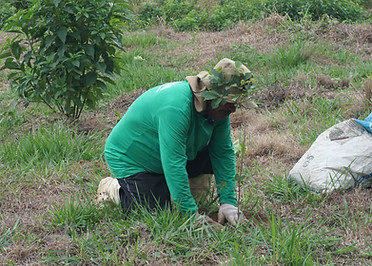
Collaborator planting a sapling - © REGUA
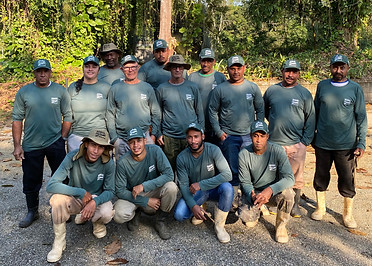
REGUA field team - © REGUA
From planning to planting, REGUA has an experienced and highly specialised technical team, some of whom have worked here since reforestation began in 2004. More than 40 employees, including reforesters, nurserymen and an important support team are needed to achieve our excellent results. This has proved that the productive chain of forest restoration generates jobs and income for a given region, since all labour is local. In addition, most of the equipment and other supplies needed are acquired from traders in the region. It is also extremely important to invest in training the workforce, with lectures, workshop and practical training.
The methodology adopted for the implementation of the projects is adapted from the technical guide prepared by the Pact for the Restoration of the Atlantic Forest, which uses four different restoration techniques:
1 - Total planting: this is the most efficient and most used form at REGUA, but also the one with the highest cost. It consists of the total formation of a forest and is normally implanted in areas where the original forest cover has been completely replaced by agricultural or agro-pastoral activity.
2 - Enrichment: a technique used in areas that already have some native vegetation, trees are planted to fill the spaces where there are gaps in natural regeneration, this method is used in places with low botanical diversity.
3 - Conducting Natural Regeneration: it is carried out mainly in areas of difficult access, which consists of isolating and protecting the area from degradation factors, such as large animals trampling the area, the risk of fires and the spread of exotic weeds. It can be considered a low-cost technique because, based on this action, the forest can regenerate and grow on its own, along with the necessary care for the development of the plants in the long term.
4 - Direct sowing: is being carried out on an experimental basis at REGUA for cost and efficiency analysis. It consists of inserting the seed directly into the soil, where there is no need to previously form the seedling and, for this reason, it can be considered a practical and less costly technique because there are no financial expenses in the seedling production stage.
The implantation and care for the establishment of the restored areas take place through successive operations. The preparation of the areas includes the construction of access roads and protection measures, including the installation of fences and firebreaks. The land is prepared by removing invasive exotic plants (weeds) from the system through mowing and weeding, and by monitoring the presence and impact of leaf-cutting ants.
For us, it is very rewarding to observe the first flowering and fruiting of the seedlings planted in each restored area. It is also very interesting to observe in these places the spontaneous arrival of new plants, colonising the natural regeneration, also of animals, such as insects, birds, rodents and small mammals. These key indicators are directly related to the functioning of the ecosystem and the effectiveness and success of restoration, thus ensuring the sustainability of these areas.
Thus, we can say that the success of REGUA's environmental restoration projects is the result of over two decades of hard work, the involvement of partners, efforts between the parties involved, the institution's experience and the proper functioning of the entire production chain. of forest restoration.